Gram-Schmidt orthogonalization



In mathematics, especially in linear algebra, Gram-Schmidt orthogonalization is a sequential procedure or algorithm for constructing a set of mutually orthogonal vectors from a given set of linearly independent vectors. Orthogonalization is important in diverse applications in mathematics and the applied sciences because it can often simplifiy calculations or computations by making it possible, for instance, to do the calculation in a recursive manner.
The Gram-Schmidt orthogonalization algorithm
Let X be an inner product space over the sub-field of real or complex numbers with inner product , and let be a collection of linearly independent elements of X. Recall that linear independence means that




implies that . The Gram-Schmidt orthogonalization procedure constructs, in a sequential manner, a new sequence of vectors such that:



The vectors satisfying (1) are said to be orthogonal.
The Gram-Schmidt orthogonalization algorithm is actually quite simple and goes as follows:
- Set
- For i = 2 to n,
- End
- For i = 2 to n,

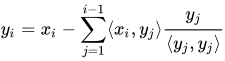
It can easily be checked that the sequence constructed in such a way will satisfy the requirement (1).

Further reading
- H. Anton and C. Rorres, Elementary Linear Algebra with Applications (9 ed.), Wiley, 2005.