In calculus, the chain rule describes the derivative of a "function of a function": the composition of two function, where the output z is a given function of an intermediate variable y which is in turn a given function of the input variable x.
Suppose that y is given as a function  and that z is given as a function
  . The rate at which z varies in terms of y is given by the derivative
  , and the rate at which y varies in terms of x is given by the derivative
  . So the rate at which z varies in terms of x is the product
  , and substituting we have the chain rule

In order to convert this to the traditional (Leibniz) notation, we notice

and
 .
.
In mnemonic form the latter expression is
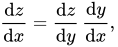
which is easy to remember, because it as if dy in the numerator and the denominator of the right hand side cancels.
Multivariable calculus
The extension of the chain rule to multivariable functions may be achieved by considering the derivative as a linear approximation to a differentiable function.
Now let  and
and  be functions with F having derivative
  at
at  and G having derivative
  at
at  . Thus is a linear map from
  and is a linear map from
  . Then
  is differentiable at with derivative

See also



