Cauchy sequence



In mathematics, a Cauchy sequence is a sequence in a metric space with the property that elements in that sequence cluster together more and more as the sequence progresses. Another way of thinking of the clustering is that the distance between any two elements diminishes as their indexes grow larger and larger.
A convergent sequence in a metric space always has the Cauchy property, but depending on the underlying space, the Cauchy sequences may be convergent or not. This leads to the notion of a complete metric space as one in which every Cauchy sequence converges to a point of the space.
Formal definition
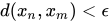
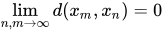
Let be a metric space. Then a sequence of elements in X is a Cauchy sequence if for any real number there exists a positive integer , dependent on , such that for all . In limit notation this is written as .



References
- Tom M. Apostol (1974). Mathematical Analysis, 2nd ed. Addison-Wesley.
- Lynn Arthur Steen; J. Arthur Seebach jr (1978). Counterexamples in Topology. Berlin, New York: Springer-Verlag. ISBN 0-387-90312-7.