In mathematics and physics, an associated Legendre function Pℓm is related to a Legendre polynomial Pℓ by the following equation

Although extensions are possible, in this article ℓ and m are restricted to integer numbers. For even m the associated Legendre function is a polynomial, for odd m the function contains the factor (1−x ² )½ and hence is not a polynomial.
The associated Legendre functions are important in quantum mechanics and potential theory.
According to Ferrers[1] the polynomials were named "Associated Legendre functions" by the British mathematician Isaac Todhunter in 1875,[2] where "associated function" is Todhunter's translation of the German term zugeordnete Function, coined in 1861 by Heine,[3] and "Legendre" is in honor of the French mathematician Adrien-Marie Legendre (1752–1833), who was the first to introduce and study the functions.
Differential equation
Define
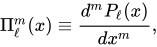
where Pℓ(x) is a Legendre polynomial.
Differentiating the Legendre differential equation:

m times gives an equation for Πml
![{\displaystyle (1-x^{2}){\frac {d^{2}\Pi _{\ell }^{m}(x)}{dx^{2}}}-2(m+1)x{\frac {d\Pi _{\ell }^{m}(x)}{dx}}+\left[\ell (\ell +1)-m(m+1)\right]\Pi _{\ell }^{m}(x)=0.}](https://wikimedia.org/api/rest_v1/media/math/render/svg/a0646d66b5288c6fcb0a223d4bd1a138025408a4)
After substitution of

and after multiplying through with  , we find the associated Legendre differential equation:
![{\displaystyle (1-x^{2}){\frac {d^{2}P_{\ell }^{m}(x)}{dx^{2}}}-2x{\frac {dP_{\ell }^{m}(x)}{dx}}+\left[\ell (\ell +1)-{\frac {m^{2}}{1-x^{2}}}\right]P_{\ell }^{m}(x)=0.}](https://wikimedia.org/api/rest_v1/media/math/render/svg/65e0b6b6c103256a203530be670df71713f3ecd1)
One often finds the equation written in the following equivalent way

where the primes indicate differentiation with respect to x.
In physical applications it is usually the case that x = cosθ, then the associated Legendre differential equation takes the form
![{\displaystyle {\frac {1}{\sin \theta }}{\frac {d}{d\theta }}\sin \theta {\frac {d}{d\theta }}P_{\ell }^{m}+\left[\ell (\ell +1)-{\frac {m^{2}}{\sin ^{2}\theta }}\right]P_{\ell }^{m}=0.}](https://wikimedia.org/api/rest_v1/media/math/render/svg/b3db05097c0b453bec6526c7657d198a6409784d)
Extension to negative m
By the Rodrigues formula, one obtains

This equation allows extension of the range of m to: −m ≤ ℓ ≤ m.
Since the associated Legendre equation is invariant under the substitution m → −m, the equations for Pℓ ±m, resulting from this expression, are proportional.[4]
To obtain the proportionality constant we consider

and we bring the factor (1−x²)−m/2 to the other side.
Equate the coefficient of the highest power of x on the left and right hand side of

and it follows that the proportionality constant is

so that the associated Legendre functions of same |m| are related to each other by

Note that the phase factor (−1)m arising in this expression is not due to some arbitrary phase convention, but arises from expansion of (1−x²)m.
Orthogonality relations
Important integral relations are:
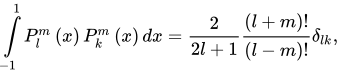
and:

The latter integral for n = m = 0
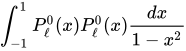
is undetermined (infinite). (see the subpage Proofs for detailed proofs of these relations.)
Recurrence relations
The functions satisfy the following difference equations, which are taken from Edmonds.[5]







Reference
- ↑ N. M. Ferrers, An Elementary Treatise on Spherical Harmonics, MacMillan, 1877 (London), p. 77. Online.
- ↑ I. Todhunter, An Elementary Treatise on Laplace's, Lamé's, and Bessel's Functions, MacMillan, 1875 (London). In fact, Todhunter called the Legendre polynomials "Legendre coefficients".
- ↑ E. Heine, Handbuch der Kugelfunctionen, G. Reimer, 1861 (Berlin).Google book online
- ↑ The associated Legendre differential equation being of second order, the general solution is of the form
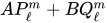 where
where  is a Legendre polynomial of the second kind, which has a singularity at x = 0. Hence solutions that are regular at x = 0 have B = 0 and are proportional to
  . The Rodrigues formula shows that
  is a regular (at x=0) solution and the proportionality follows.
- ↑ A. R. Edmonds, Angular Momentum in Quantum Mechanics, Princeton University Press, 2nd edition (1960)



